Greases
Waterproof, extreme pressure grease
Interflon
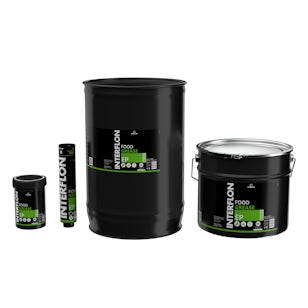
Food Grease EP
High performance, extreme pressure grease fortified with MicPol®. Designed for adverse conditions of extreme loads and high water wash areas. Providing excellent protection against rust, corrosion and wear. Excellent choice for the lubrication of slow to moderate moving bearings, sliding surfaces, open gears, etc in food safe areas. Allows to safely extending service intervals to reduce costly maintenance, lubricant consumption and energy usage.
NSF H1, NSF 537 and NSF 538 certified, making the grease fully compliant for incidental food contact.
Distinctive Properties and Key Advantages
- Reduces friction and wear significantly better than conventional lubricants
- Prolong device service life at high pressure
- Prevents loss of lubricating protection under wet conditions
- Inhibits rust and corrosion
- Outstanding emergency-run characteristics
- PFAS-free
Product Application Areas
Applications include the lubrication of general machinery, including the bearings of filling-, packaging- and molding machines, mixers and presses, slide ways, gear wheels and ball joints as well as agricultural equipment.
Frequently Asked Questions
Grease washes out of bearings after washdown when water reaches the bearing with enough force to displace the lubricant film, or when the grease mixes with water and loses its structure. Several factors usually play a role together: the pressure and frequency of cleaning, the condition of the seals and the water resistance of the grease itself. Once the film thins, metal surfaces lose their protection, which opens the door to wear and corrosion.
Interflon Food Grease EP is designed for high water wash areas. In the ASTM D4049 water washout test it shows a loss of only 1.5%, indicating high resistance to water spray under test conditions. It is NSF H1 registered for incidental food contact.
The grease is formulated with MicPol® technology. Polarised particles adhere to the metal surface, helping the lubricant film stay where it is needed rather than being rinsed away.
Even so, no grease is completely immune to washout. How long the film lasts depends on cleaning pressure, water temperature, the detergents used and the condition of the seals, so relubrication intervals should follow the actual conditions on the line.
Not sure how often to relubricate bearings in your washdown area?
Our Technical Advisors can assess your cleaning regime and operating conditions to help you determine suitable relubrication intervals, with no obligation.
Ask a Technical Advisor
Relevant content:
Greased bearings can still rust in wet areas when moisture reaches the steel surface through thin spots in the lubricant film, or when the grease offers too little corrosion protection for the conditions. Water from cleaning and salty or aggressive environments can both contribute. A bearing that is greased on schedule is therefore not automatically protected against corrosion.
Interflon Food Grease EP is formulated to protect against rust and corrosion in wet environments. In the SKF Emcor test with salt water (DIN 51802), it scores 0-0, the best possible result on a scale that runs from 0 (no corrosion) to 5.
Rust is not always caused by the lubricant alone, though. Existing surface damage, long standstill periods and condensation during downtime can also play a part, and a new grease will not reverse corrosion that is already present.
Seeing rust on bearings that are greased on schedule?
A Technical Advisor can help identify which factors are at work in your situation. No obligations.
Ask a technical Advisor
Relevant links:
Grease can break down with alkaline cleaning because alkaline agents, especially when used frequently or at higher temperatures, can attack or emulsify some greases. The grease softens, loses its structure and is washed away more easily, leaving surfaces exposed to wear and corrosion.
Interflon Food Grease EP is formulated to protect parts against wear and corrosion in alkaline environments, which makes it suited to production areas where alkaline cleaning is part of the routine.
How well any grease holds up depends on the concentration of the cleaning agent, the temperature, the contact time and whether the component is sprayed directly or only exposed to splashing. The same grease can behave differently on two lines with different cleaning regimes.
Want to check whether your cleaning regime and your grease are a good match?
Our Technical Advisors can review both together with no obligation.
Ask a Technical Advisor
Related content:
Slow-moving, heavily loaded bearings can wear quickly because a lubricant film builds up less easily at low speed. When a heavy load is added, the film can become too thin to keep the surfaces fully apart, and metal-to-metal contact causes wear. A grease with a base oil viscosity that is too low for the application is a common contributing factor, alongside overload, contamination and misalignment.
Interflon Food Grease EP is designed for slow to moderate speed components under extremely high loads. Its base oil viscosity of 400 cSt at 40 °C helps maintain a load-bearing film in conditions where a lower base oil viscosity may not be sufficient.
MicPol® technology adds to this: micronised particles smooth out surface roughness, reducing the peaks where metal contact starts.
A higher viscosity is not always better, however. At higher speeds, a thick base oil can generate more heat and resistance. The grease has a Dn factor of 250,000 (bearing bore in mm multiplied by rpm), which indicates the upper speed limit it is suited to.
Not sure whether your bearing speed and load call for a higher-viscosity grease?
Ask a Technical Advisor, without obligations.
Related content:
EP on a grease stands for extreme pressure. EP greases contain additives that protect metal surfaces when the load is so high that the normal lubricant film can break down. Without that protection, surfaces can scuff or even weld together at contact points.
A common way to measure this is the four-ball weld load test (ASTM D2596), which determines the load at which steel test balls weld together. The higher the value, the more load the grease can carry. Interflon Food Grease EP has a four-ball weld load of 450 kg.
An EP rating alone does not determine whether a grease suits an application. Base oil viscosity, speed and operating temperature are just as important.
Related content:
Some food-grade greases can handle steam cleaning, but resistance varies considerably between products. Steam combines heat and moisture, which can soften a grease, make it run and allow water to penetrate the lubricant film.
Interflon Food Grease EP has very high resistance to water, pressure and steam. It has an application temperature range of −20 °C to 170 °C and a dropping point of 265 °C (DIN 51801). The dropping point indicates when a grease turns liquid in a lab test and is not a working temperature. The grease is NSF H1 registered for incidental food contact, and NSF 537 (PFAS-free) and NSF 538 (MOAH-free) certified.
How the grease performs in practice depends on the steam temperature, how long the component is exposed and whether the steam is aimed directly at it. Relubrication after intensive steam cleaning may still be needed.
Planning to introduce or intensify steam cleaning on a line?
A Technical Advisor can help you assess the effect on your lubrication.
Related content: