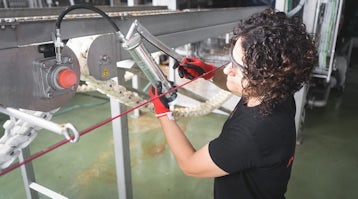
Missed or inconsistent lubrication is the leading cause of premature bearing failure, accounting for 56% of cases. Technicians are not always available, some points are unsafe or hard to reach, and results vary even when rounds are completed. That is why we combine the right system, the right lubricant and expert application advice for proven results.
Which system fits your application, and what does it deliver?
A practical guideline: if a machine has more than four lubrication points, or if those points are difficult or unsafe to reach, automation is worth assessing.
50–80% reduction
85% reduction
3–8% reduction
Single Point Lubricator
Offering Lubricants with MicPol® technology Single point solution Time based Easy to install Low investment
Application Stand-alone bearings & chains, Direct mounting on lubrication point Hard to reach area’s Low critical equipment Operating pressure <10 bar
Offering Lubricants with MicPol® technology Multiple lubrication points >4 PLC (linked to production) or internal controller 24V/DC or 230V/AC powered Small or large volume relubrication of grease or oil
Application Bearings, chains, linear guides, pin-bush Complete machines, production lines Protection / data logging Medium and critical equipment Operating pressure >10 bar
Across structured Interflon lubrication programs, customers also see a 10 to 30% reduction in unplanned downtime, depending on the site's current failure patterns.
Why automate lubrication?
Manual lubrication depends on the right person reaching the right point, at the right time, with the right lubricant and the right quantity. When that does not happen consistently, the risk of premature wear, failure and unplanned downtime increases.
Depending on the situation, automatic lubrication helps resolve:
Labour shortage: fewer skilled technicians available for repetitive manual lubrication tasks.
Hard-to-reach points: height, guarding, and moving parts make manual lubrication slow, and time-consuming.
Safety: less exposure of people to hazardous or hard-to-reach lubrication points, and less spilled lubricant that can cause slippery floors.
Inconsistent lubrication: missed rounds, incorrect lubricant selection and inconsistent application increase the risk of premature wear and failure.
Downtime cost: missed lubrication points can lead to reactive maintenance, which costs more than automation.
Compliance and audit: food and pharmaceutical sectors require documented, traceable lubrication.
Interflon, together with our preferred suppliers Graco and ISPL solutions (Interflon Single Point Lubricators), has 600+ Technical Advisors in 52 countries. NSF and PFAS-free certified.
Arjan van der Valk
Product Manager Lubrication Systems
An automatic lubrication system only performs when the hardware, lubricant and setup work together. A system on its own is not enough. Matching it to the right lubricant and setting it up correctly is what determines whether it performs. That is why we combine proven lubrication systems with Interflon lubricants featuring MicPol® technology and on-site technical expertise.
Next step
A Technical Advisor assesses the application, identifies the right system and lubricant, and calculates a realistic return on investment based on documented cases.
An automatic lubrication system delivers a fixed amount of grease or oil to a lubrication point at set intervals or in sync with production cycles, without a technician needing to visit the point. This prevents missed lubrication rounds and ensures consistent protection for bearings and chains.
The return on investment comes from several cost reductions at once: fewer labour hours on manual lubrication rounds, less wear on bearings and chains from consistent dosing, less unplanned downtime from missed lubrication points, lower lubricant consumption through precise delivery, and lower energy use from reduced friction.
Interflon supplies lubricants with NSF H1 and NSF 3H certification and PFAS-free formulations, suitable for use in and around food production. These lubricants are fully compatible with the Interflon Single Point Lubricators and the Interflon Centralized Lubrication System. Everything you need to know about NSF Certification for Lubricants.