Lubricants account for 1–3% of maintenance spend, while their selection and application influence 15–40% of total maintenance costs — often without full control.
Lubrication as a Service (LaaS®)
LaaS® is Interflon’s modular lubrication management programme for industrial sites that want to reduce lubrication costs, lubricant consumption and unplanned downtime. Depending on site needs, lubrication management can remain in-house, be shared with Interflon or be fully outsourced. LaaS® combines specialist lubricants, lubrication planning, execution and traceability. MicPol® technology helps extend lubrication intervals by maintaining an effective lubricating film for longer, while ILAC® records intervals, execution and consumption so improvements can be measured and documented. Building blocks are selected based on site maturity and operational priorities. There is no fixed scope or minimum commitment.
Measured outcomes across LaaS® customer sites
These outcomes are based on results measured across Interflon LaaS® customers in food, beverage and industrial manufacturing. Individual results depend on baseline practices, site complexity and programme scope.
15–40% reduction in total lubrication costs
50–80% reduction in lubricant consumption
10–30% reduction in unplanned downtime (MTBF/OEE improvement)
3–8% energy savings
ROI typically achieved within 12 months on full programme scope, based on measured customer results.
TCO outcomes are always site-specific and are established through a baseline assessment and the resulting business case.
Identify your main lubrication risks and improvement potential:
Why lubrication management is a maintenance lever most sites underuse
Lubrication accounts for 1–3% of the maintenance budget, yet lubrication practice influences up to 40% of total maintenance cost (Source: SKF). That gap is typically caused by how lubrication is selected, applied and managed across the site.
56% of premature bearing failures are lubrication-related (Source: SKF). These failures typically originate in incorrect selection, application or uncontrolled storage conditions.
The root causes are consistent across sites:
Labour shortages lead to missed lubrication intervals and inconsistent route execution
Lubrication knowledge that resides with individuals rather than systems creates execution risk during absence or workforce changes
Lubrication plans that are incomplete or not maintained result in intervals based on convention rather than asset requirements
Excess lubricants and suppliers increase misapplication and contamination risk on the shop floor
Increasing audit requirements expose traceability gaps that were previously not recorded as findings
Unstructured lubricant storage is a direct source of contamination risk and misapplication
Why LaaS® delivers results that conventional lubrication service cannot
Most lubrication services focus on product supply or task-based execution. They do not address the system: the plan, the intervals, the traceability, the knowledge retention. LaaS® does all of these, and it is built on MicPol® technology.
Across LaaS® customer sites, this approach has resulted in 50–80% lower lubricant consumption and measurably longer lubrication intervals.
Once implemented, LaaS® performance is tracked through agreed KPIs established at programme start: lubrication task compliance, lubricant consumption, MTBF and OEE trends, and energy use on lubricated assets. Deviations trigger a root cause analysis with documented corrective action and follow-up. This turns lubrication management from a scheduled activity into a controlled, improving process.
How do you know if your plant needs structured lubrication management?
LaaS® is relevant when lubrication execution is affecting planned maintenance performance, driving corrective maintenance, or creating audit and safety exposure. LaaS® is commonly implemented when a site needs to:
Reduce supplier complexity and consolidate to a single lubrication partner
Extend lubrication intervals without increasing reliability risk
Document execution consistently across shifts and teams
Meet increasing audit requirements, including ICML 55.1, ISO 55001, BRCGS and IFS
Curious to find out which indicators apply to your site?
Proof in practice
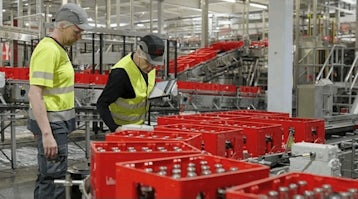
Coca-Cola Europacific Partners (NL) recognised lubrication as a specialised discipline and engaged Interflon to professionalise it. The programme moved the site to an audit-ready system, reduced lubricant consumption by 80% and extended gearbox oil intervals from two to three years to over a decade, achieved through improved practice, automation and a structured lubrication programme.
As a Maintenance Manager, I focus on results: less downtime, lower costs and greater reliability. Thanks to Interflon’s products and expert support, we save an average of 40% on lubricants and labour, fully comply with all food safety regulations and contribute to our sustainability goals. That combination has made Interflon a truly valuable partner for over 25 years.'
Food and beverage manufacturing
Lubrication management in food and beverage production is subject to strict audit requirements: food-grade lubricant traceability, contamination prevention and documented lubrication intervals are non-negotiable. LaaS® supports these requirements through ILAC® documentation, consolidation to approved lubricants and execution controls that hold up to BRCGS, IFS and customer audits.
Interflon food-grade lubricants are NSF H1 registered, NSF 3H certified for direct food contact, PFAS-free, MOAH-free and suitable for use in Halal and Kosher certified environments. The combination of NSF H1 and NSF 3H certification in a single PFAS-free range is rare in the industry and eliminates the need for separate product lines based on contamination zone.
Rail and transport
Unplanned asset downtime in rail and transport carries immediate operational and safety consequences. LaaS® is implemented across rolling stock, infrastructure maintenance and depot operations where consistent lubrication execution across shifts and locations is a measurable driver of asset availability. MicPol® lubricants perform under the variable load, vibration and contamination conditions typical of rail environments.
Heavy industry and manufacturing
In heavy industry, including steel, cement, paper, mining and process manufacturing, the value case for LaaS® is driven by asset criticality and the cost of unplanned stops. LaaS® brings structured interval management, automated lubrication points and ILAC® traceability to environments where lubrication has historically been managed reactively. Interflon Technical Advisors operate across more than 52 countries and adapt the programme to sector-specific asset criticality and compliance frameworks.
LaaS® building blocks
LaaS® building blocks are implemented in any combination, starting with what delivers the most immediate impact for the site. There is no fixed sequence and no minimum scope. Scope can be extended as the programme develops and priorities evolve.
Programme modules
Training on lubrication knowledge
ILAC® digital lubrication management software for planning and traceability
A lubrication assessment reviews current lubrication management practices, identifies the main risk areas and defines which LaaS® building blocks are relevant to the site. The outcome is a documented overview of lubrication management gaps and the expected impact of addressing them. There is no obligation to proceed beyond the assessment.
Lubrication as a Service (LaaS®) is Interflon's modular lubrication management programme. It gives industrial maintenance teams a structured framework for controlling lubrication cost, reliability and audit readiness — with the flexibility to implement as many or as few building blocks as the site requires. Building blocks cover products, lubrication systems, planning, traceability and execution support, selected based on site maturity and operational priorities. Interflon lubrication execution and a fixed-fee contract are available as delivery options. The programme is managed through ILAC®, Interflon's cloud-based lubrication management software.
An industrial lubrication management provider helps plan, control and improve lubrication across a site. This can include lubrication assessments, route and interval optimisation, lubricant selection, execution support, documentation, reporting and performance monitoring. Interflon provides these services through LaaS®, with ILAC® software supporting lubrication planning, traceability and audit-ready documentation.
Industrial lubrication management can be outsourced when internal capacity or specialist lubrication knowledge is limited, lubrication routes and intervals are not executed consistently, or stronger reporting and audit traceability are required. Depending on the site, lubrication management can remain in-house, be shared with a specialist, or be fully outsourced. Interflon provides industrial lubrication management through LaaS®, combining lubrication planning, technical expertise, execution support and traceability in a modular programme.
LaaS® is well suited to single-facility operations. Programme scope is defined by what is relevant for the site, not by its size. For smaller operations, LaaS® typically starts with a structured lubrication plan in ILAC® and consolidation to a single approved lubricant supplier. This delivers immediate reductions in misapplication risk and audit exposure without a full programme rollout, and results are measurable within weeks of implementation. A lubrication assessment identifies the highest-impact starting point and defines a scope that fits the site's capacity and priorities.
LaaS® does not replace the in-house maintenance team. It is designed to work alongside existing teams, supporting and structuring their work rather than substituting it. Many sites retain full execution responsibility in-house and use LaaS® for the programme infrastructure: structured lubrication plans, digital work instructions in ILAC® and consistent traceability across all work performed. Interflon lubrication execution is available as a delivery option when internal capacity is a constraint.
Value is measured by establishing a baseline before the programme starts and tracking agreed indicators over time. Cost indicators cover total lubrication expenditure, lubricant consumption and corrective maintenance workload attributable to lubrication. Reliability indicators cover unplanned downtime frequency, Mean Time Between Failure (MTBF) and Overall Equipment Effectiveness (OEE) trends. Compliance indicators cover execution adherence and traceability completeness as documented in ILAC®. Interflon Technical Advisors establish the baseline at programme start and review progress at agreed intervals.
A structured lubrication plan in ILAC® for a single facility is typically completed within 4 to 8 weeks of the lubrication assessment. Broader programmes including Vendor Managed Inventory, automation and execution support are phased across a schedule agreed at programme start, with milestones defined upfront so progress is measurable from day one. In both cases, results are visible before the full programme is complete: lubrication intervals, consumption and compliance traceability are tracked against the baseline from the moment implementation begins.
A LaaS® engagement starts with a lubrication assessment conducted by an Interflon Technical Advisor. The assessment reviews current lubrication practices, identifies the main risk areas across cost, reliability and compliance, and defines which building blocks are relevant. The outcome is a documented overview of lubrication management gaps and the expected impact of addressing them.
The first step is a lubrication assessment: an Interflon Technical Advisor maps current lubrication practices, identifies the main risk areas and defines which building blocks are relevant. Based on the assessment findings, a pilot scope is agreed, focused on high-impact assets where lubrication-related losses are most measurable. Implementation covers lubrication routes, intervals, product selection and execution documentation in ILAC®, including automation and Vendor Managed Inventory where relevant. Once implemented, the programme is reviewed at agreed intervals. Mean Time Between Failure (MTBF), Overall Equipment Effectiveness (OEE), lubricant consumption and compliance traceability are tracked against the baseline established at programme start.
LaaS® is modular by design. Implementation starts with the building blocks most relevant to the site's current situation, from as targeted as a lubrication plan in ILAC® to as broad as a full managed programme including Vendor Managed Inventory, automation and execution support. Scope can be extended as the programme develops and priorities evolve.
Traditional lubrication services typically focus on product supply or task-based execution without structured programme management. LaaS® introduces clear scope, ownership and traceability across the full lubrication management process, documented in ILAC®, Interflon's cloud-based lubrication management software, which records every lubrication task, interval and finding in an auditable format. It is also built on MicPol® technology, which extends lubrication intervals and reduces consumption in ways that conventional lubricants cannot achieve, meaning the programme delivers structural improvement, not just process improvement.
ILAC® is the traceability layer of the LaaS® programme. The software documents lubrication points, routes and work instructions with photo-supported step-by-step guidance, records work performed including findings and proof of execution, and generates audit-ready reports for compliance purposes. ILAC® ensures that lubrication work is planned, executed and documented consistently, regardless of which team member performs it.
LaaS® adds most value when lubrication management needs to scale beyond what internal capacity or knowledge can sustain. This includes sites where audit requirements are tightening, where lubrication intervals need to be extended in a documented and controlled way, or where supplier complexity is creating misapplication risk. LaaS® is also effective as a framework for in-house teams: the programme infrastructure, lubrication plan in ILAC® and Technical Advisor support give internal teams the structure to execute consistently, without replacing them. Many sites use LaaS® not because in-house management is failing, but because structured programme management delivers better outcomes than execution alone.