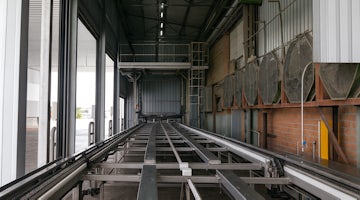
With conditions from freezing to scalding all in the same line
Food-Grade chain lubrication across 45 conveyors, from freezing to scalding
Case summary
A large Belgian pork processing plant operates 45 overhead conveyor systems under widely varying conditions, requiring lubrication strategies tailored to each application.
- Operating conditions: cooling areas documented at 0°C and 100% humidity, water at 60–65°C with steam exposure, chlorinated washdown and heavily contaminated processing areas.
- Lubrication challenge: Different chains require different lubricant properties, application methods and lubrication intervals.
- Approach: Food Lube G150 is used across multiple chain systems, while Food Lube AL is applied in selected automatic and temperature-exposed conveyor applications.
- Technical takeaway: NSF H1 classification alone is not sufficient for lubricant selection. Temperature, moisture, contamination, cleaning regime, viscosity and application method also determine lubricant suitability and chain reliability.
The starting point
Food-grade chain lubrication becomes considerably more complex when operating conditions change from one conveyor to the next.
At this Belgian pork processing plant, 45 overhead conveyor systems operate across slaughter, transport, cooling and washing processes. Some conveyor areas are documented at 0°C and 100% humidity, while others expose chains to water at 60–65°C, steam, chlorinated water, contamination or intensive cleaning.
Because the conveyor systems form a linear production sequence, an unplanned stoppage on one chain has a direct knock-on effect on the lines that follow it, which raises the operational stakes of getting lubrication right at every point.
One scalding-tank chain, for example, is exposed to water documented at 60–65°C with continuous steam exposure. It requires weekly manual lubrication, using approximately three litres of lubricant per lubrication round across the full chain loop.
Quick-cooling and refrigerator-input chains face very different conditions. These applications operate in areas documented at 0°C and 100% humidity, where moisture and condensation increase the importance of corrosion protection.
Other chain systems are exposed to water mist, chlorinated water or heavy contamination.
For the maintenance team, this means NSF H1 classification is only the starting point. Lubricant selection must also reflect the actual operating environment, including temperature, moisture, contamination, cleaning regime and application method at each lubrication point.
The lubrication approach
Over several years, Interflon has worked with the plant to rationalise its lubricant range and match lubricants and application methods more closely to individual operating conditions.
Interflon Food Lube G150 is used across multiple conveyor systems, including overhead transport, cooling, inspection and washing applications.
Other applications require a different approach. Interflon Food Lube AL is used at selected automatic lubrication points and has also been designated for temperature-exposed conveyor applications, including the singeing/cooling section.
This application-specific approach means evaluating factors such as:
- operating environment and relevant temperatures
- water, steam and cleaning-chemical exposure
- contamination
- lubricant penetration
- risk of dripping
- lubrication frequency
- manual or automatic application
- required food-safety classification
Lubricant viscosity also matters. On one conveyor, a third-party PAO 150 food-grade lubricant was trialled but removed because of excessive dripping. Food Lube G150 was subsequently reinstated.
Although both products carry the same nominal ISO VG 150 viscosity grade, viscosity alone does not determine how a lubricant behaves in the application. Formulation, film formation and adhesion to the metal surface also matter.
Food Lube G150 incorporates Interflon’s MicPol® technology, which uses micronised and polarised additives to form a smooth, resilient, surface-bound tribofilm that reduces friction and provides long-lasting protection. In this application, Food Lube G150 showed better film adherence, while the third-party alternative did not.
This illustrates why food-grade classification and viscosity grade alone are not enough to determine suitability. The lubricant still has to perform under the actual temperature, moisture, contamination and application conditions of the conveyor.
Application method is also part of the strategy. Automatic lubrication is operational on two chain systems at the plant. Automatic lubrication can be particularly useful where consistent delivery is required or where manual access is labour-intensive.
It does not remove the need to select the correct lubricant, quantity and interval, but it can provide more consistent delivery when properly specified.

Operational outcomes
The approach has resulted in a more application-specific and controlled lubrication strategy across the plant.
Several operational outcomes are directly documented:
- Food Lube G150 was reinstated after an alternative PAO 150 lubricant caused excessive dripping.
- Automatic oil lubrication is operational on two chain systems at the plant.
- Lubricants are selected according to different combinations of temperature, moisture, contamination and application method.
- Products identified as unsuitable from a food-safety perspective during audits were replaced with appropriate H1 products.
The lubrication strategy is also adjusted when operating conditions change.
After a water-mist system was introduced in a quick-cooling area, corrosion was observed on conveyor components. An automatic lubrication system is currently being evaluated to improve lubricant delivery under these changed conditions.
This illustrates an important point: lubrication optimisation is not a one-time product switch. Changes in cleaning processes, equipment or operating environment can alter what a lubrication point requires.
Facing variations in operating conditions on your conveyors? Let us help.
Food safety and compliance
Lubrication at the plant is also governed by BRC (BRCGS) food-safety requirements.
Daily veterinary hygiene inspections at the plant also cover lubricant leaks as a contamination risk, adding a further layer of routine scrutiny alongside periodic BRC audits.
During audits, non-H1 products were identified at lubrication points within the production environment. These were replaced with appropriate H1 alternatives, including Interflon Food Grease MP2 on slaughter-conveyor turning wheels and Interflon Food Grease HD on open drive stations.
For chain applications, Food Lube G150 is NSF H1 registered, ISO 21469 certified and NSF 537 certified PFAS-free.
These classifications and certifications are important, but they address only part of the lubricant-selection decision.
An H1 lubricant must still be technically suitable for the mechanical and environmental conditions of the application.
Technical takeaway
This plant demonstrates why food-grade chain lubrication should be treated as an engineering decision, not simply a purchasing category.
The stakes are tangible. On a linear line, an unplanned stoppage does not stay local, it interrupts the lines that follow it. And a lubricant flagged as non-compliant during an audit is not a paperwork issue, it is a compliance finding that can affect certification. Treating lubrication as an engineering decision, rather than a purchasing category, is what keeps both risks under control.
Across 45 overhead conveyor systems, operating conditions range from cold, saturated environments to applications exposed to hot water, steam, washdown and contamination.
There is therefore no single specification that defines the best lubricant for every chain.
Effective lubricant selection starts by understanding the chain, its operating environment and the lubrication-related problem that needs to be controlled.
Instead of asking:
“Which food-grade lubricant should we use?”
a more useful question is:
“What does this chain need from its lubricant under the conditions in which it actually operates?”
That is the basis for selecting the right lubricant, application method and lubrication interval.
Recognise variation in conditions across your own conveyors?
Request a free site-specific lubrication assessment from a Technical Advisor.
Frequently asked questions
One food-grade lubricant cannot necessarily be used for all conveyor chains. Food-grade conveyor chains can operate under very different loads, temperatures, moisture levels, cleaning regimes and contamination conditions. The lubricant should meet the required food-safety classification and also be technically suitable for the specific application.
Washdown can affect chain lubrication by reducing lubricant retention and corrosion protection. Water, steam and cleaning processes can change how effectively the lubricant remains at the lubrication point. Applications exposed to frequent washdown therefore require lubricant selection and lubrication intervals that account for those conditions.
BRC and BRCGS refer to the same food safety certification. BRC (British Retail Consortium) was the original name of the standard, developed in 1998. Following its acquisition by LGC Group, it was rebranded as BRCGS (Brand Reputation through Compliance Global Standards) in 2019. Both terms are still used interchangeably across the food industry.
NSF H1 alone is not enough to select a food-grade chain lubricant. NSF H1 indicates that a lubricant is suitable for applications where incidental food contact may occur, but it does not determine whether the lubricant has the right viscosity, temperature behaviour, water resistance or application characteristics for a particular chain.
Automatic chain lubrication should be considered where consistent lubricant delivery is required, lubrication points are difficult to access or manual lubrication creates substantial maintenance work. The lubricant, quantity and lubrication interval still need to be correctly specified for the application.
Selecting a food-grade chain lubricant requires information about the chain and its actual operating conditions. Important factors include chain type, operating environment, relevant temperatures, speed and load, exposure to water or cleaning chemicals, contamination, lubrication method, required lubrication interval and applicable food-safety requirements.