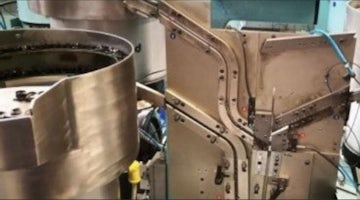
Lubrication interval extended sevenfold, lubricant consumption reduced by almost 90%
Euro-Mit Staal in Vlissingen identified excessive wear in the recoiler of a slitting line and sought a permanent solution. The cause proved to lie in the lubrication mechanism. This article explains how the application of Interflon Grease LS2 with MicPol® technology extended the maintenance interval sevenfold.
Dennie Minderhoud
Maintenance Planner, Euro-Mit Staal B.V.
“In less than eighteen months, Interflon has taken lubrication maintenance throughout our entire plant to a higher level. Thanks to their advice and the right lubricants, we have avoided having to shut down one of our slitting lines every month for dismantling and cleaning. We have now extended the interval to seven months, reduced lubricant consumption by almost 90% and gained control over our quality.”
EMS’s slitting lines process master coils of electrical steel weighing approximately 9,000 kg. The recoiler rewinds the slit steel under a continuously high load and at a low circumferential speed. During every cycle, the comb-and-wedge mechanism inside the recoiler shaft must slide with sub-millimetre precision.
This combination of high contact pressure and low speed places the lubricant in the boundary lubrication regime: the region of the Stribeck curve where the lubricating film is at its thinnest and most at risk of being displaced from between the contact surfaces. This is precisely the regime in which most lubrication failures begin in practice.
Wear analysis: why boundary lubrication requires a specific lubricant
Applications involving high contact pressures at low speeds, such as the comb-and-wedge mechanism inside the recoiler shaft, place considerable demands on the lubricant. A conventional multipurpose EP grease is inadequate in this regime because it lacks one critical mechanism: durable adhesion to the surface.
The wear pattern when surface adhesion is absent:
Metal particles from the sliding comb-and-wedge surfaces migrate into the grease
The grease does not adhere to the metal surface and keeps the particles suspended
Over time, the increasing concentration of particles forms an abrasive paste
This paste accelerates wear on the sliding surfaces
Increasing wear causes the recoiler shaft to lose precision
Galling marks in the shaft chamber in which the comb and wedge move.
Black grease was found in the recoiler during the annual major maintenance shutdown, although no action was initially taken. When functional problems subsequently developed in the moving components, Interflon recognised the black grease as an indication of lubricant-related wear. To establish the extent of the problem, a pilot was set up in which the mechanism was initially dismantled and cleaned and the grease replaced every month, providing a one-month baseline.
The solution: MicPol® technology in the boundary lubrication regime
Interflon Grease LS2 is a highly cohesive EP grease containing MicPol® technology. It was specifically developed for applications involving high contact pressures and low speeds. The micronised particles used in MicPol® technology smooth out microscopic surface irregularities, while the polarised particles adhere to the metal surface.
The result is an adhesive barrier that does not depend solely on film thickness. Even under the high contact pressure exerted by a nine-tonne steel coil, the surface-bound layer remains intact. Contamination with metal particles does not impair this adhesion mechanism. The lubricating film remains intact, wear is inhibited and the lubricant retains its protective effect for up to seven months.
Left: Competing product – black contamination caused by wear particles Right: Interflon Grease LS2 – the lubricating film can still be felt upon inspection
Property
Interflon Grease LS2 with MicPol® technologie
Surface adhesion
Adheres to the metal surface through MicPol® technology
Behaviour under high pressure
The lubricating film remains intact through surface bonding, even under heavy loads
Contamination behaviour
Metal particles are repelled, preventing the formation of an abrasive paste
Condition after one month
Cohesive, with the lubricating film still fully present and perceptible during inspection
Maintenance interval
Seven months, established following a pilot using a one-month baseline
From pilot results to plant-wide Lubrication as a Service
Following the successful pilot, Interflon was asked to conduct a comprehensive lubrication audit of the EMS plant. Every lubrication point across the five slitting lines and their associated equipment was documented and assigned the appropriate product, interval and application quantity based on the actual operating conditions.
This marked the transition to Interflon’s Lubrication as a Service (LaaS®) approach. Euro-Mit Staal continues to carry out the lubrication work itself, while Interflon provides the lubrication plan, the right lubricants and digital assurance through ILAC®.
The data was implemented in ILAC®, Interflon’s cloud-based lubrication management software. The system automatically schedules every lubrication task at the correct time, digitally records every action and exports a complete audit trail for quality reviews.
Is your lubricant determining your maintenance interval?
At EMS, a lubrication audit delivered a fully documented lubrication programme for five production lines in less than 18 months. Interflon can conduct the same analysis at your site.